
Des Moines residents voted yes on Nov. 4, for the future of DMPS. The $265 million bond passed with 73.6 percent of voters approving and now DMPS will expand like never before.
The bond passing is just the first step in a very large operation; the bond will not change schools overnight; these changes will be seen throughout the upcoming years. Everybody wants to know when the community is expected to see these changes, well the answer is there has been changes; freshman on track was put into place this 2025-2026 school year. The goal is for all ninth graders to leave their freshman year with at least five credits helping graduation rates. By the upcoming spring, we will start to physical changes to Brody and McCombs which are both adding 6,000 square feet to the premises. One of the final changes we will in the close future is Walnut St. School will close that the end of 2025-2026 school year. As these improvements start to happen, the goal is that students will be proud of going to a Des Moines Public School and leaving a legacy behind.
“I was really careful to say to people this is the first step, this is not the answer. This is not the solution. This is step one. In a 500-step process that we hope five, seven, ten years from now, results in a school system where when you come in in pre-kindergarten, a family is really sure about the path of their student all the way through,” school board member Patrick Dix said.
Many people are not sure exactly how school bonds work.
“We ask the community to basically lend us the money, in order to do this. And so the school district will sell bonds, other entities will buy those bonds and they’ll be paid back with interest, and we’ll use that money to then, build up our facilities,” Dix said.
This decision to ask the residents of Des Moines did not come without scrutiny.
“A lot of people said, ‘why can’t you just do this with the money that you already get?’ A lot of even adults said, ‘you know, we didn’t need to do this when I was in school.’ Well, back in the 70s, when they were in school, the year over year increased for funding for schools was about 8 percent in the state of Iowa. In the 80s, that went down to five percent. And in the 90s, it crept down to where we are now, which is about two percent (increase in state funding) every year. I would love it if we were funding schools the way we were back in the 70s, which is an eight percent year over year increase, we probably could get a lot of this done if the funding came that way. That’s not the way that our elected lawmakers have chosen to do it,” Dix said.
The bond will bring big improvements to schools across the district, including updated classrooms, safer entrances, and better technology. According to Director of Career and Technical Education and Postsecondary Readiness Tascha Brown, these changes will give students more comfortable and modern spaces to learn in and help teachers create a stronger learning environment.
“Once these facilities are built, it will allow us to have space to bring career and tech Ed like what’s at Central Campus into the middle schools. And so, every middle school that’s getting that space will have a class called Medical Detectives where they just get to explore all things Health Sciences. There will be robotics and engineering, these beautiful maker spaces so that kids can take their math and reading and science skills and build something, create something… Start thinking about their jobs,” Brown said.
Dix attended a community meeting, and he remembers a moment he will never forget.
“One of the students looked at me and said, ‘I don’t know why I’m here. I know I have to be here, but I don’t know why I’m here. I don’t have a reason for coming here every day.’ And that really has stuck with me about giving our kids a reason to come to high school,” Dix said.
This has prompted DMPS to include career and technical training programs as part of the Reimagining Education initiative. According to DMPS, “The Diploma+ program will provide more opportunities to students and better prepare them for their future. Every DMPS student will have a clear pathway to explore their interests and prepare for career, college or whatever is next for them. The learning will start in preschool with important life skills and build throughout all the grade levels. By the time they graduate, students will have multiple opportunities to prepare for the future, resulting in special Diploma+ distinctions and certificates.”
Working in education isn’t just about teaching kids, it’s about giving students a pathway into their future.
“My work is never about my children. It’s about our children in the world, and I just, that’s why I’m in education. It just makes me so happy, when I see people in the community that I went to high school with and like their kids in some cases, their grandbabies, it’s just, it’s legacy work,” Brown said.
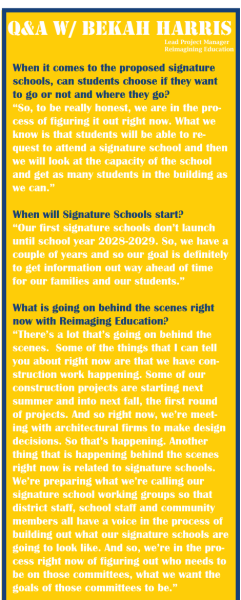
Increasing access to full-day preschool was one of the main focuses for the Reimagining Education plan because early childhood education has proven to create a solid foundation for the cognitive, social and emotional development of each student. This is an exciting change for families. This will not only benefit the children in helping improve literacy rates, but it will also help working class families because they will no longer have to worry about providing transportation for their child midway through the day.
“When kids don’t have access to pre-school, they are less likely to be reading at grade level by third grade,” East Principal Jill Versteeg said. “If you’re not reading at grade level by third grade it just gets that much harder.”
 DMPS is confident this investment will pay off.
“Research says that every dollar invested in pre-K saves us $17 on the back end because we don’t have to pay for so many resources, whether socioeconomic, educational, the incarceration rates are lower,” Brown said.
Within the last few months, Prairie Meadows invested $550,000 into DMPS full day preschool. This will send about 180 students to full day preschool. These are students that ended up losing scholarships through Early Childhood Iowa Education, that was once paid through the state. These funds have been reallocated.
“The funding streams get really complicated, and unfortunately after this school year, were actually losing our full day preschool classrooms that are funded by the city of Des Moines. The city of Des Moines gave us about $3 million three years ago. And that funding will stop or be dried up, basically, at the end of this year. So those full day classrooms are going to be no longer unless we can find $1 million,” Chief of Staff and Philanthropic Engagement Kayli Becker said.
Des Moines Public Schools does not take the increase in taxes lightly and appreciates the investment from taxpayers.
“We know that it might seem like a lot for a $200 increase a year in property taxes. As taxpayers, we have to pay when systems don’t work for people. And so that just was a really cool, pretty powerful statistic that I know has like lodged in my brain now,” Brown said.